News
A2026-04-07
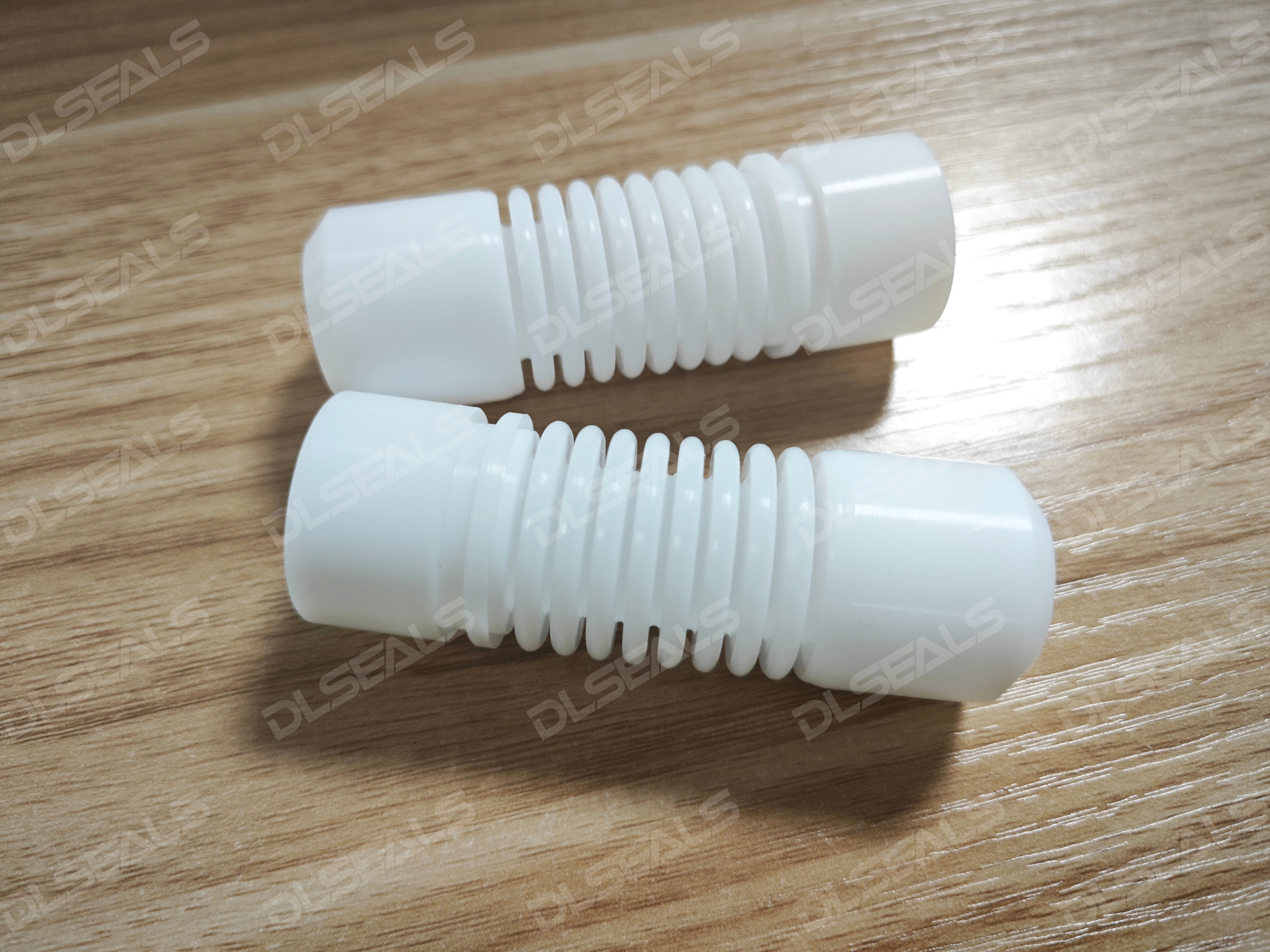
In modern industrial fluid systems, balancing chemical stability, flexibility, and temperature resistance is a constant technical challenge. PTFE bellows, with their unique geometric structure and superior material properties, have become the preferred component for handling highly corrosive media, ultra-clean fluids, and high-frequency vibration environments.
PTFE (commonly known as "the king of plastics") is the ideal substrate for bellows due to its stable molecular structure of carbon-fluorine bonds:
Extreme Chemical Inertness: Resists almost all chemical reagents (including strong acids, bases, and organic solvents), reacting only with molten alkali metals or fluorinating agents at high temperatures.
Wide Temperature Range: Maintains physical stability from -60℃ to +260℃
Low Coefficient of Friction: Smooth inner walls prevent material buildup and bacterial growth.
Excellent Aging Resistance: Unaffected by ozone or UV, offering an exceptionally long service life.
Standard rigid PTFE tubing lacks flexibility and is prone to kinking. The corrugated (bellows) design transforms the mechanics of the tube to provide:
Displacement Compensation: Absorbs axial, lateral, or angular movement caused by thermal expansion and contraction.
Vibration Damping: Acts as a flexible connection for pumps and compressors, blocking vibration transfer to the network.
Tight Bend Radius: Allows for sharp turns in confined spaces without reducing the flow area.
Extrusion: PTFE fine powder mixed with lubricant is extruded into a base tube.
Bellows Forming: The base tube is heated and shaped using blow molding or mechanical radial compression.
Sintering: Performed at approximately 370℃ to reorganize molecular chains, set the shape, and enhance mechanical strength.
For high-pressure or specialized environments, PTFE bellows are often reinforced:
External Braiding: Usually Stainless Steel (SUS304/316) to increase pressure resistance and prevent the bellows from elongating under pressure.
Anti-static Lining: Carbon black is added to the PTFE to dissipate static electricity generated by high-speed fluid friction.
Flanged Fittings: Flaring the PTFE over the flange face ensures "zero metal contact" for pure fluid transport.
[DLSEALS kindly Reminder] Sealing issues? Turn to DLSEALS! As a sealing component manufacturer, we specialize in customizing sealing components, providing a full range of services from design, research and development, production, testing, and more. If you have more information you'd like to know, feel free to contact us directly. DLSEALS's product experts are dedicated to serving you!

GUANGDONG DLSEALS TECHNOLOGY CO.,LTD.
TEL/Whatsapp
:+86 15918359971ADDRESS
:No. 2 Niujiaokeng Road, Baizhoubian, Dongcheng District, Dongguan, Guangdong, China.