News
A2025-07-15
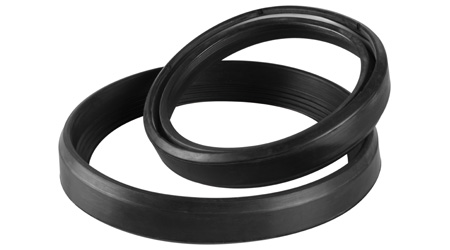
In extreme sealing environments involving high pressure, high speed, and severe wear, Aramid Fabric Reinforced Seals serve as a critical defense line. By combining high-strength aramid fibers with oil-resistant rubber, these seals deliver unparalleled anti-extrusion and anti-wear performance in rotating shafts, reciprocating pistons, and valve applications. Below is an in-depth analysis of their core properties:
The "sandwich structure" (rubber matrix-reinforcement fabric-rubber matrix) enables breakthrough performance:
High-Strength "Skeleton": Aramid Fabric Layer
Flexible "Muscle": Rubber Matrix
Synergistic Effects
| Parameter | Aramid Fabric Seals | Pure Rubber Seals | Metal-Reinforced Seals |
|---|---|---|---|
| Max. Pressure | 80–100 MPa | 20–40 MPa | >100 MPa |
| Extrusion Resistance | ★★★★★ | ★★☆☆☆ | ★★★★★ |
| Wear Resistance | ★★★★☆ (Abrasive) | ★★☆☆☆ | ★★★★☆ |
| Max. Linear Speed | 20–30 m/s | ≤15 m/s | ≤5 m/s (lubricated) |
| Shock Load Adaptability | Excellent | Good | Poor (brittle) |
| Weight | Light (1.4 g/cm³) | Light | Heavy (7.8 g/cm³) |
Structure Optimization
Rubber Matrix Selection
| Condition | Recommended Rubber | Properties |
|---|---|---|
| Fuel (>150°C) | FKM | Chemical resistance |
| Lubricant (135°C) | HNBR | Low compression set |
| Water-glycol | EPDM | Hydrolysis resistance |
Failure Prevention
| Failure Mode | Cause | Solution |
|---|---|---|
| Delamination | Rubber-fabric bond failure | Use thermo-vulcanization |
| Fiber fraying | Over-compression (>30%) | Limit to 15–25% |
| Groove wear | Contamination | Add 80μm pre-filter |
Conclusion:
Aramid fabric seals achieve the impossible through "rigidity against pressure, flexibility against wear":
[DLSEALS kindly Reminder] Sealing issues? Turn to DLSEALS! As a sealing component manufacturer, we specialize in customizing sealing components, providing a full range of services from design, research and development, production, testing, and more. If you have more information you'd like to know, feel free to contact us directly. DLSEALS's product experts are dedicated to serving you!

GUANGDONG DLSEALS TECHNOLOGY CO.,LTD.
TEL/Whatsapp
:+86 15918359971ADDRESS
:No. 2 Niujiaokeng Road, Baizhoubian, Dongcheng District, Dongguan, Guangdong, China.