News
A2026-09-09
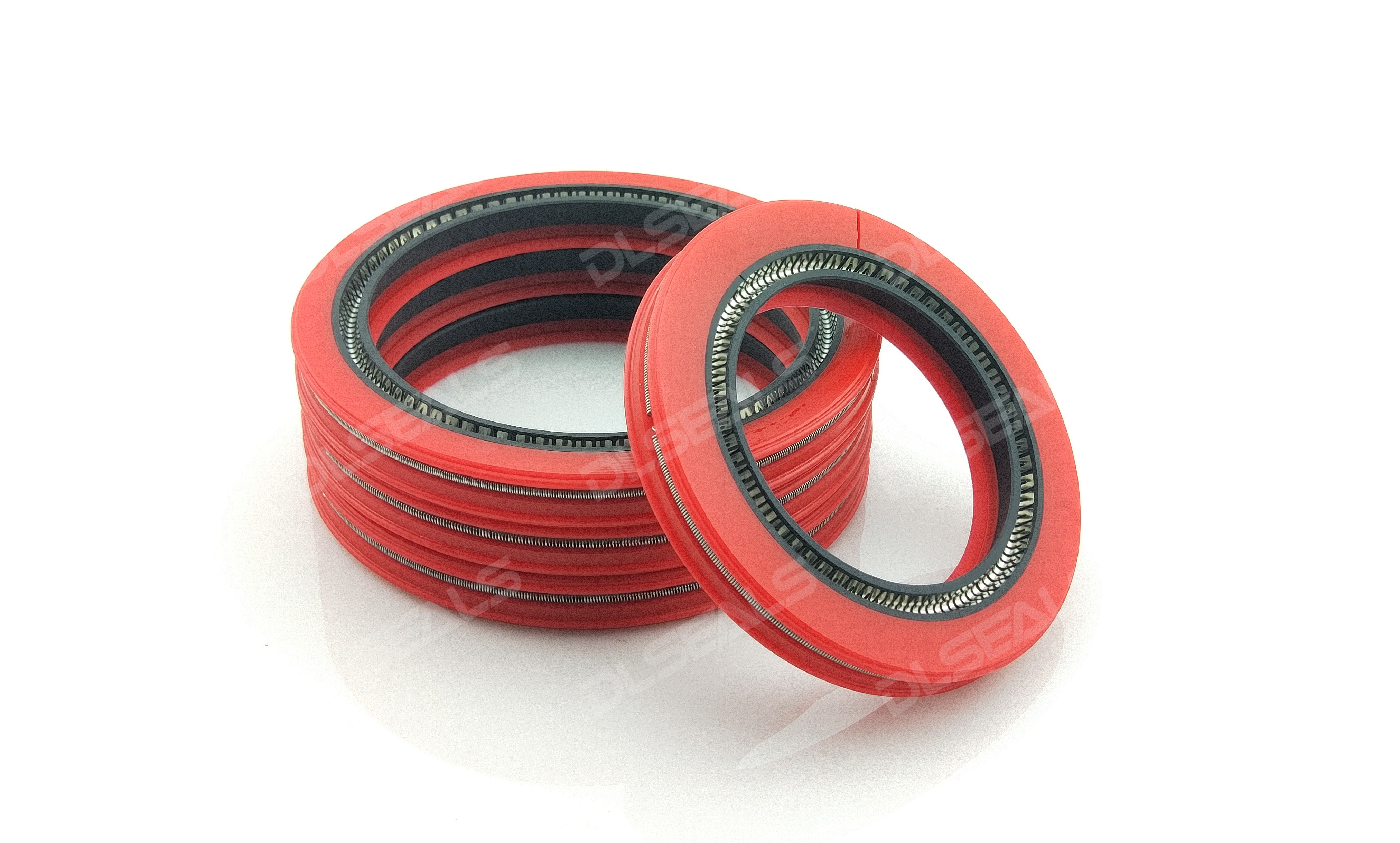
In large rotating equipment, gearboxes, drive shafts, fans, pumps, gear units, and continuous-production machinery, oil seals are commonly installed between the shaft and housing to prevent lubricant leakage while keeping dust, water, and other contaminants out of the equipment. However, for some large machines, replacing a conventional one-piece oil seal may require removing bearings, couplings, or even the entire shaft, resulting in high maintenance costs and extended downtime.
Split oil seals are designed specifically to address these challenges. Their key feature is that the seal can be split into separate sections and installed around an existing shaft, allowing replacement without removing the rotating shaft. This makes split oil seals particularly suitable for large rotating equipment and applications where field maintenance and equipment disassembly are difficult.
A split oil seal is a rotary shaft seal designed for installation without removing the shaft. Unlike conventional one-piece oil seals with an integrated structure, split oil seals generally consist of two or more sections that are assembled around the shaft using specially designed split joints, connection structures, or fastening methods.
During installation, the seal can be positioned directly around an already-installed shaft and then joined to form a complete sealing ring. This eliminates the need to remove large components from the shaft end in many applications.
The basic sealing principle is similar to that of conventional rotary oil seals. The sealing lip maintains controlled contact with the rotating shaft, generating an appropriate radial sealing force to limit lubricant leakage while the lip geometry helps prevent external contaminants from entering the equipment.
The major difference is therefore not how the seal works, but how it is installed and maintained.
One of the most critical design features of a split oil seal is the split joint.
Because the seal is divided into multiple sections, the joint must maintain sufficient sealing performance after installation. Otherwise, the split location may become a potential leakage path. For this reason, a split oil seal cannot simply be produced by cutting a conventional oil seal into sections. The joint requires dedicated structural design.
Common joint configurations include stepped joints, angled joints, labyrinth-type structures, and special overlapping designs. These structures increase the length and complexity of the leakage path, reducing the possibility of lubricant escaping directly through the split interface.
For high-speed rotating shafts, the dynamic stability of the split joint also requires particular attention. An improperly designed joint may cause local deformation, abnormal friction, or increased leakage. The split joint, sealing lip, and shaft surface therefore need to be considered as an integrated sealing system.
Some designs also incorporate springs, metal reinforcement, or other structural elements to maintain stable radial preload and mechanical rigidity.
The most significant advantage of a split oil seal is that the rotating shaft generally does not need to be removed during seal replacement.
For large gearboxes, industrial fans, paper-making machinery, mining equipment, marine drive systems, and large transmission systems, replacing a conventional one-piece oil seal may require the removal of bearings, couplings, gears, or other shaft-end components. This can significantly increase labor requirements and equipment downtime. Reassembly may also require additional alignment or bearing adjustments.
With a split design, the seal can be installed directly around the existing shaft, greatly reducing the amount of disassembly required.
Split oil seals are therefore particularly suitable when:
The shaft diameter is large and handling a one-piece seal is difficult.
The shaft or shaft-end components cannot be easily removed.
Equipment downtime must be minimized.
Field maintenance conditions are limited.
Seals require periodic replacement on large equipment.
Replacing a conventional oil seal would require extensive disassembly.
For large industrial equipment, reducing maintenance time is itself an important part of sealing-system efficiency.
Although split oil seals offer significant maintenance advantages, they are not a universal replacement for conventional one-piece oil seals.
One-piece oil seals have a continuous structure, mature manufacturing technology, and fewer discontinuities in the sealing interface. For smaller shafts, easily accessible shaft ends, and equipment that is simple to disassemble, conventional oil seals are often more economical.
A split oil seal, on the other hand, introduces a split joint and therefore places higher demands on joint design, manufacturing accuracy, and installation quality.
For high-speed, high-pressure, or extremely low-leakage applications, the dynamic sealing capability of the split joint should be carefully evaluated. Where appropriate, the seal design should be selected based on shaft diameter, rotational speed, medium, temperature, and allowable leakage.
Therefore, the real advantage of a split oil seal is not that it always provides better sealing performance, but that it can provide reliable rotary shaft sealing with significantly lower maintenance costs in specific equipment configurations.
Material selection for a split oil seal should be based on the operating medium, temperature, rotational speed, and shaft-surface condition.
For general industrial lubricants, suitable elastomer materials can be selected according to operating temperature and speed. For high-temperature applications or environments requiring higher oil resistance, materials such as FKM may be considered. For high-speed applications, low-friction requirements, or special media, PTFE and filled PTFE materials may provide additional advantages.
In addition to the sealing material, lip geometry is also critical. The number of sealing lips, lip angle, contact pressure, and spring arrangement can directly affect friction, heat generation, and leakage.
Where both lubricants and external contaminants such as dust or water are present, a dual-lip configuration can be used. The primary sealing lip controls lubricant leakage while the secondary dust lip helps prevent external contaminants from entering the equipment.
For large shafts, shaft hardness, surface roughness, runout, concentricity, and existing wear should also be carefully evaluated. Even a properly designed oil seal may leak if the shaft surface has developed significant grooves, corrosion, or uneven wear.
Although split oil seals simplify installation, this does not mean that installation requirements are less demanding.
Before installation, the shaft surface and seal housing should be thoroughly cleaned. The shaft should be inspected for scratches, corrosion, wear grooves, and excessive eccentricity. During installation of the split joint, the specified orientation and joining method should be followed carefully to prevent joint misalignment, opening, or local lifting.
Sharp tools should not be used to force the sealing lip into position, as this may cause permanent deformation or damage.
For large equipment, shaft runout and overall machine vibration should also be evaluated. Excessive eccentricity or vibration can cause continuous movement of the sealing lip and result in abnormal wear and leakage, even when the seal itself has been installed correctly.
The actual service life of a split oil seal therefore depends not only on the sealing material, but also on the compatibility between the seal design, shaft surface, equipment accuracy, installation method, and operating conditions.
Split oil seals are mainly used in large equipment or applications where removing the rotating shaft is difficult, including:
Large gearboxes
Industrial fans
Large pumps and pump systems
Paper-making machinery
Mining and metallurgical equipment
Marine drive systems
Gear units
Conveyor systems
Power-generation equipment
Large industrial transmission systems
These applications generally involve large shaft diameters, complex disassembly procedures, or significant economic losses caused by equipment downtime.
When selecting a split oil seal, a practical question can be asked first:
Does replacing the oil seal require removing the rotating shaft or large shaft-end components?
If equipment disassembly is difficult, downtime is expensive, and the seal is a regularly maintained component, a split oil seal can offer significant practical advantages.
The final selection should also consider shaft diameter, rotational speed, pressure, temperature, lubricant, external contamination, shaft condition, and allowable leakage. For large rotating equipment, the seal should not be selected based solely on its dimensions. The oil seal should be matched with the shaft, housing, bearings, and overall transmission system.
The core value of a split oil seal is not simply a change in the shape of a conventional oil seal. Its primary purpose is to solve practical maintenance problems in large rotating equipment, particularly difficult seal replacement, excessive equipment downtime, and the inability to remove the shaft or shaft-end components.
Through appropriate split-joint design, sealing-lip geometry, material selection, and reinforcement structures, split oil seals can be installed and replaced without removing the rotating shaft, providing a more efficient maintenance solution for large industrial equipment.
For large gearboxes, fans, pumps, gear units, paper-making machinery, and other continuously operating equipment, reducing maintenance time and downtime while maintaining reliable sealing performance is one of the most important advantages of split oil seals.
[DLSEALS kindly Reminder] Sealing issues? Turn to DLSEALS! As a sealing component manufacturer, we specialize in customizing sealing components, providing a full range of services from design, research and development, production, testing, and more. If you have more information you'd like to know, feel free to contact us directly. DLSEALS's product experts are dedicated to serving you!

GUANGDONG DLSEALS TECHNOLOGY CO.,LTD.
TEL/Whatsapp
:+86 15918359971ADDRESS
:No. 2 Niujiaokeng Road, Baizhoubian, Dongcheng District, Dongguan, Guangdong, China.