News
A2026-10-23
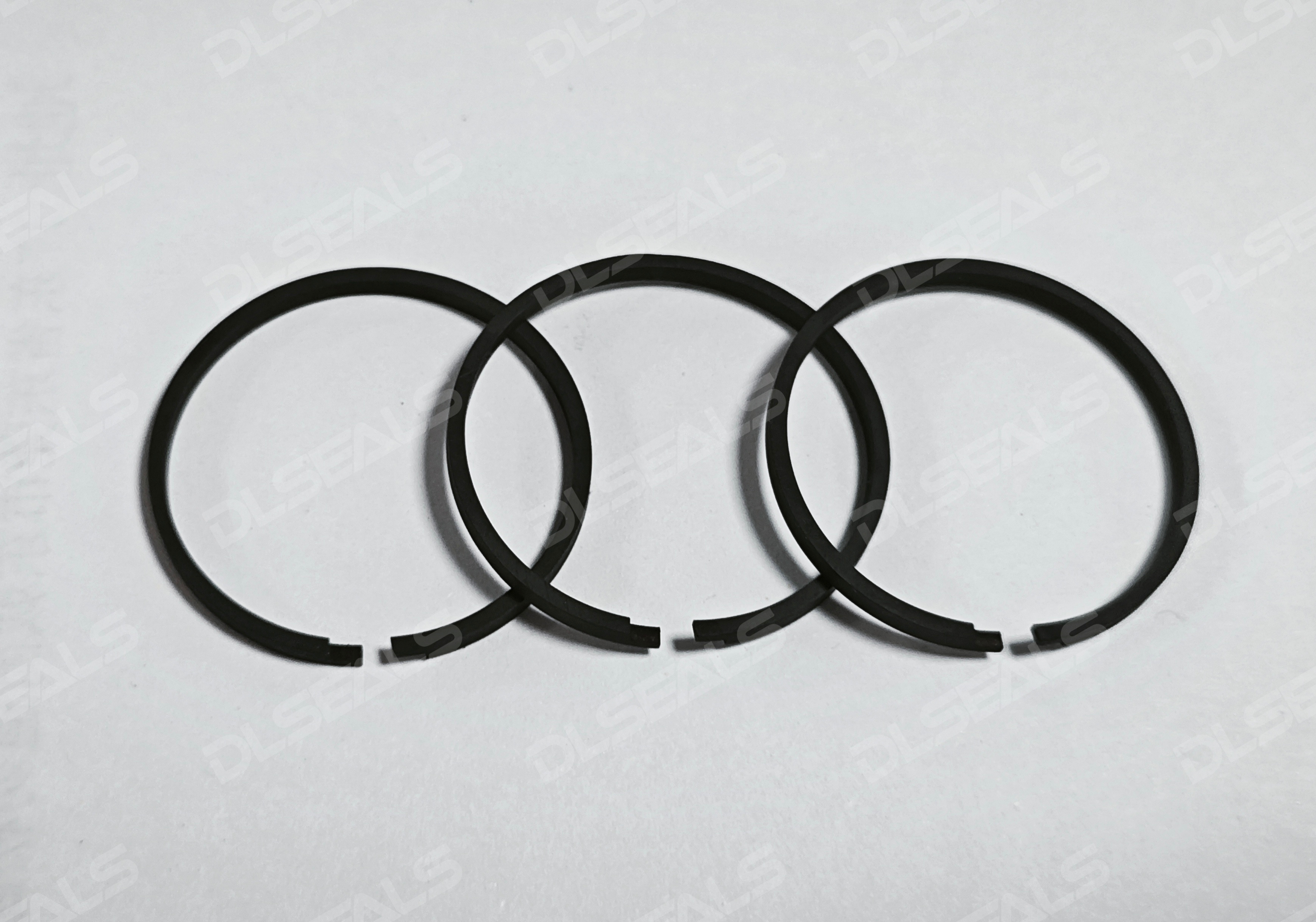
In hydraulic cylinders, pneumatic equipment, compressors, and various reciprocating machines, the interaction between the piston and cylinder bore directly affects sealing performance, operational stability, and equipment service life. In addition to sealing elements responsible for controlling fluid leakage, piston rings and wear rings are essential components of these systems.
Although piston rings and wear rings are often installed in similar locations, their primary functions differ. Piston rings are mainly designed for sealing, pressure separation, and leakage control, while wear rings primarily provide guidance, load support, and protection against direct metal-to-metal contact. In certain applications, specially designed materials and structures can combine these functions.
As industrial equipment continues to develop toward higher pressures, faster operating speeds, longer service life, and reduced maintenance requirements, engineering plastics such as PTFE, PEEK, and polyamide are increasingly used in piston rings and wear rings. Selecting suitable materials and structural designs according to actual operating conditions is essential for improving equipment reliability.
Piston rings are generally installed in circumferential grooves on the outer diameter of a piston. Through contact with the cylinder wall or a controlled clearance, they provide sealing, pressure separation, or leakage control.
Depending on the equipment, piston rings can be manufactured from metal, PTFE, PEEK, or other engineering materials. For example, piston rings in reciprocating compressors restrict gas leakage from the high-pressure side to the low-pressure side, while piston sealing rings in hydraulic systems must establish effective sealing contact under operating pressure.
Wear rings, also known as guide rings or bearing rings, are usually installed in corresponding grooves on pistons or piston rods. Their main functions are to withstand radial loads, maintain guidance accuracy, and prevent direct metal-to-metal contact between moving components.
The main differences are summarized below:
| Comparison | Piston Rings | Wear Rings |
|---|---|---|
| Primary function | Sealing, pressure separation, leakage control | Guidance, load support, prevention of metal contact |
| Main loads | Pressure differential, radial contact force, friction | Radial load and sliding friction |
| Typical installation | Piston sealing grooves | Piston or rod guide grooves |
| Common materials | PTFE, PEEK, metals, composites | PTFE, fabric-reinforced phenolic composites, PA, PEEK |
| Design priorities | Leakage control, friction, wear, sealing contact | Load capacity, wear resistance, clearance, guidance stability |
| Typical applications | Compressors, hydraulic cylinders, pneumatic equipment | Hydraulic cylinders, construction machinery, reciprocating equipment |
In reciprocating compressors, piston rings and rider rings generally perform separate sealing and load-bearing functions. Similarly, hydraulic piston seals and guide rings often operate together as part of an integrated sealing system.
Material selection directly affects friction coefficient, wear resistance, load-bearing capacity, creep resistance, and the potential wear of mating surfaces.
1. PTFE and Modified PTFE
Polytetrafluoroethylene (PTFE) offers a low coefficient of friction, excellent chemical resistance, and a broad operating temperature range, making it a commonly used material for piston rings and wear rings.
However, virgin PTFE has relatively low mechanical strength, limited wear resistance in certain applications, and a tendency to creep under sustained loading.
To improve these properties, PTFE is often modified with fillers such as carbon fiber, glass fiber, graphite, or bronze.
Carbon-fiber-filled PTFE can be suitable for dynamic applications requiring improved wear resistance, friction performance, and heat dissipation. Glass-fiber-filled PTFE may provide improved dimensional stability and creep resistance, while bronze-filled PTFE is used in certain lubricated sliding applications.
Different fillers influence friction behavior, mechanical properties, and their interaction with mating surfaces. Therefore, the formulation should be selected according to the specific tribological system.
2. PEEK Engineering Plastic
Polyether ether ketone (PEEK) provides high mechanical strength, good creep resistance, and excellent heat resistance, making it suitable for certain high-load, high-temperature, and dimensionally demanding sealing applications.
Compared with conventional PTFE, PEEK generally offers higher stiffness and load-bearing capability. It can therefore be used for heavy-duty piston rings, support rings, and specialized wear components.
However, PEEK generally has a higher coefficient of friction than PTFE. Its greater stiffness also requires careful consideration of shaft and cylinder surface quality.
For high-speed, dry-running, or poorly lubricated conditions, specially modified wear-resistant PEEK grades may be necessary.
3. Polyamide (PA/Nylon)
Polyamide offers good mechanical strength, wear resistance, impact resistance, and machinability. It is commonly used for guide rings, support rings, and wear rings in hydraulic cylinders and mechanical equipment.
PA6, PA66, and PA12 have different performance characteristics. PA6 and PA66 offer balanced mechanical properties, while PA12 generally exhibits lower moisture absorption and better dimensional stability under changing humidity conditions.
The main limitation of polyamide is that moisture absorption can affect its dimensions and mechanical properties. This must be considered in humid environments, water-based media, and precision assemblies.
4. Fabric-Reinforced Phenolic Composites
Fabric-reinforced phenolic composites provide good load-bearing capability, compressive strength, and wear resistance. They are commonly used in guide rings and bearing rings for heavy-duty hydraulic cylinders.
These materials are particularly suitable for reciprocating equipment subjected to substantial radial loads and requiring high structural stiffness.
However, friction behavior, moisture absorption, and operating temperature limits depend on the specific material formulation and manufacturing process.
In hydraulic cylinders and other reciprocating equipment, pistons are subjected not only to axial operating pressure but also to radial forces resulting from installation misalignment, external loading, and equipment movement.
Without adequate guidance, the piston may tilt or become eccentric, causing direct contact between its metallic outer surface and the cylinder bore.
This can lead to cylinder scoring, metal wear, increased friction, and eventual damage to the primary sealing elements.
The main purpose of a wear ring is to provide a sliding support interface with sufficient load-bearing capability between the piston and cylinder.
Supporting Radial Loads
Wear rings distribute radial loads through their mechanical strength and effective contact area, reducing the likelihood of direct metal-to-metal contact.
Maintaining Guidance Accuracy
Properly positioned wear rings help limit piston tilting and excessive radial displacement, maintaining more stable alignment during reciprocating movement.
Protecting Primary Seals
Piston eccentricity or tilting may cause localized overcompression, lip wear, or extrusion damage to the main seals. Wear rings help reduce these risks by improving component guidance.
Reducing Maintenance Costs
Properly designed wear rings serve as replaceable wear components, helping protect more expensive metal parts such as cylinders and pistons from severe damage.
Although wear rings are generally not responsible for primary sealing, they have a significant influence on the service life of the entire sealing system.
The sealing mechanism of a piston ring depends on the equipment type, operating medium, and structural design.
In reciprocating compressors, piston rings typically use their inherent elasticity, installation geometry, and gas pressure differential to establish contact with the cylinder wall and restrict gas leakage.
In hydraulic systems, PTFE piston sealing rings may be combined with elastomeric energizers. The elastomer provides initial contact pressure, while hydraulic pressure further energizes the sealing interface.
Some piston rings feature split designs to accommodate installation, thermal expansion, and operating deformation.
Common joint configurations include straight cuts, angled cuts, and stepped joints. Each design affects installation convenience, leakage paths, and the ability to accommodate wear.
In compressors requiring improved leakage control, multiple piston rings may be installed to distribute pressure reduction along the axial direction, reducing the pressure differential across individual rings.
However, increasing the number of piston rings does not necessarily result in unlimited leakage reduction. Ring quantity, contact pressure, frictional heat, and pressure distribution must be carefully balanced.
1. Hydraulic Cylinders and Construction Machinery
In hydraulic cylinders, piston seals primarily separate hydraulic fluid between the two chambers and maintain operating pressure, while wear rings provide piston guidance and radial load support.
In heavy-duty equipment such as excavators, lifting machinery, and hydraulic presses, properly combining PTFE sealing rings, wear rings, and auxiliary sealing elements can improve hydraulic system stability.
2. Reciprocating Compressors
Piston rings in reciprocating compressors primarily restrict gas leakage through the clearance between the piston and cylinder. Rider rings support the weight of the piston assembly and other radial loads.
Modified PTFE and PEEK materials are used in certain oil-free and special-gas applications.
Material selection must account for gas composition, pressure differential, operating temperature, piston speed, and frictional heat generation.
3. Pneumatic Equipment and Automation Systems
Pneumatic actuators generally require low friction, stable movement, and long service life.
Low-friction PTFE piston seals may be used in precision pneumatic systems, while polyamide or other engineering plastic guide rings provide mechanical support.
For high-frequency reciprocating motion, particular attention should be paid to breakaway friction, lubrication, and long-term wear.
4. Pumps and Other Reciprocating Equipment
Piston rings and wear rings may also be used in appropriate sealing and guiding positions in plunger pumps, reciprocating pumps, and other industrial machinery.
For equipment exposed to abrasive particles, corrosive media, or elevated temperatures, materials must be selected for suitable wear resistance, chemical compatibility, and dimensional stability.
Operating Pressure and Contact Load
Piston rings must be designed according to the operating pressure differential and the required sealing performance.
Wear rings should be evaluated based on actual radial loads and effective bearing area to determine the resulting contact pressure.
For heavily loaded wear rings, compressive strength alone is insufficient for material selection. Long-term creep, localized loading, and actual contact area must also be considered.
Operating Speed and PV Value
In dynamic sealing and guiding applications, the combination of contact pressure and sliding velocity influences friction, wear, and heat generation.
The PV value is commonly used to evaluate the suitability of sliding materials. However, its definition and allowable limits depend on the material testing method and actual contact conditions.
Under dry-running or high-speed conditions, frictional heat and material thermal stability become especially important.
Operating Temperature and Fluid Compatibility
PTFE, PEEK, polyamide, and fabric-reinforced phenolic composites have different temperature limits and chemical resistance characteristics.
PTFE provides excellent chemical resistance, while polyamide may be affected by moisture absorption and certain fluids.
PEEK offers advantages at elevated temperatures, but actual load and friction conditions must still be evaluated.
Installation Clearance and Thermal Expansion
Piston ring and wear ring dimensions must account for cylinder bore diameter, groove geometry, material thermal expansion, moisture-related dimensional changes, and operating temperature.
Insufficient clearance may increase friction or cause seizure, while excessive clearance can reduce guidance accuracy or increase leakage.
Mating Surface Quality
Cylinder bore roughness, hardness, roundness, and surface treatment directly influence the service life of piston rings and wear rings.
For composite materials containing hard fillers, their potential abrasive effect on mating metal surfaces must also be considered.
During long-term operation, piston rings and wear rings may experience abnormal wear, fracture, extrusion deformation, localized overheating, or increased leakage.
Excessive Piston Ring Wear
Rapid wear may result from excessive contact pressure, insufficient lubrication, rough mating surfaces, or abrasive contamination entering the sealing area.
Localized Crushing or Deformation of Wear Rings
These failures may be caused by excessive radial loading, insufficient effective bearing area, unsuitable material stiffness, or long-term creep.
Ring Fracture
Fracture may result from installation stresses, impact loading, material brittleness, or improper joint geometry.
Abnormal Leakage
Increased leakage may be associated with piston ring wear, excessive end-gap clearance, unfavorable pressure distribution, or cylinder surface damage.
To address these problems, engineers should evaluate material formulation, ring cross-section, groove design, installation clearance, mating surface quality, and actual operating conditions.
Simply increasing material hardness or adding more sealing rings does not necessarily resolve wear and leakage problems.
Although piston rings and wear rings may have similar configurations, they perform different functions in industrial sealing systems.
The primary function of piston rings is to control leakage and maintain pressure separation, while wear rings are designed to withstand radial loads, guide moving components, and protect metallic mating surfaces.
Advances in engineering plastics and composite materials have expanded the available options, including modified PTFE, PEEK, polyamide, and fabric-reinforced phenolic materials.
For high-pressure hydraulic systems, high-speed reciprocating compressors, and other demanding industrial equipment, proper material selection, structural design, and installation of piston rings and wear rings can help reduce friction and wear, prevent sealing failures, and improve operational stability and service life.
In practical engineering applications, operating pressure, sliding speed, temperature, fluid compatibility, radial load, and installation clearance should form the basis of material and structural selection.
By coordinating sealing functions with guidance and load-support functions, engineers can achieve more reliable and durable industrial sealing performance.
[DLSEALS kindly Reminder] Sealing issues? Turn to DLSEALS! As a sealing component manufacturer, we specialize in customizing sealing components, providing a full range of services from design, research and development, production, testing, and more. If you have more information you'd like to know, feel free to contact us directly. DLSEALS's product experts are dedicated to serving you!

GUANGDONG DLSEALS TECHNOLOGY CO.,LTD.
TEL/Whatsapp
:+86 15918359971ADDRESS
:No. 2 Niujiaokeng Road, Baizhoubian, Dongcheng District, Dongguan, Guangdong, China.