News
A2026-11-04
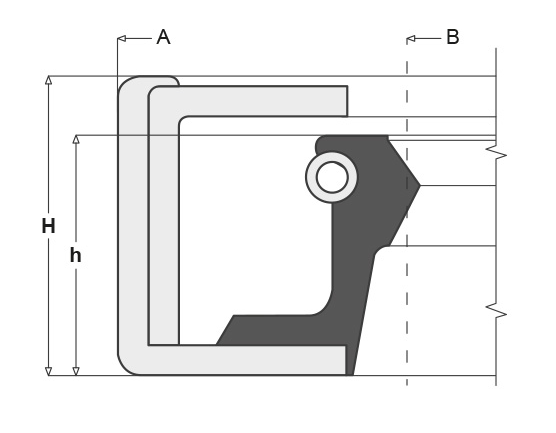
The L2-type L-shaped oil seal is a radial shaft seal featuring a combination of a metal outer casing and an L-shaped metal insert. It is primarily designed to seal the interface between a rotating shaft and its housing, preventing lubricant leakage while keeping external dust and contaminants out of the equipment.
Compared with conventional rotary shaft seals, the L2-type oil seal incorporates an additional reverse L-shaped metal insert. This structure provides protection and reinforcement around the sealing lip, improving structural stability and reducing the risk of lip deformation during operation.
Its main components include:
Metal Outer Casing: Provides overall structural support and secures the oil seal in the housing through interference fitting.
L-Shaped Metal Insert: Reinforces and protects the sealing lip, improving the mechanical stability of the sealing area.
Rubber Sealing Lip: Contacts the rotating shaft to perform the primary dynamic sealing function.
Garter Spring: Applies continuous radial force to the sealing lip, compensating for minor wear and changes in material elasticity to maintain sealing contact.
By combining metal and rubber components, this design offers a balance of installation stability, sealing performance, and structural reliability.
The L2-type oil seal primarily relies on contact between the rubber sealing lip and the rotating shaft to achieve radial sealing. Once installed, the elasticity of the rubber and the force exerted by the garter spring keep the sealing lip in close contact with the shaft, forming a continuous circumferential sealing interface that prevents lubricant from escaping along the shaft.
During operation, a microscopic lubricating film forms between the sealing lip and the shaft surface. Proper lip geometry, contact pressure, and shaft surface conditions help maintain a stable oil film, reduce friction and wear, and ensure consistent sealing performance.
The L-shaped metal insert is an important feature of this design. It provides additional mechanical support to the sealing area and reinforces the rubber structure around the sealing lip. In equipment subject to vibration or varying operating loads, this reinforcement helps maintain the dimensional stability of the sealing assembly.
It should be noted that the L2-type oil seal is a radial shaft seal. Its performance is still affected by shaft speed, surface roughness, operating temperature, lubrication conditions, and installation misalignment. The internal metal insert does not mean that the oil seal is suitable for high-pressure applications.
According to the design specifications, the L2-type oil seal has a reference maximum operating pressure of 0.5 bar (approximately 0.05 MPa). It is primarily intended for low-pressure or near-atmospheric rotary shaft sealing applications.
Typical applications include:
Metalworking Industry: Sealing rotating shafts in various mechanical equipment to prevent lubricant leakage.
General Industrial Machinery: Suitable for gearboxes, transmission systems, and other rotating machinery.
Wind Power Industry: Can be used in selected rotating shaft sealing applications in transmission and auxiliary equipment, depending on the actual operating conditions.
Power Generation Equipment: Used for sealing lubricants around relevant rotating components.
When selecting an oil seal, operating pressure should not be the only consideration. Shaft speed, surface hardness and roughness, lubricant type, operating temperature, and possible axial or radial displacement must also be evaluated.
If the equipment is exposed to elevated internal pressure, significant pressure fluctuations, or substantial shaft misalignment, the sealing design should be reassessed rather than selecting an L2-type oil seal based solely on its external dimensions.
In addition to standard catalog sizes, L2-type oil seals can be custom-designed to suit specific installation spaces and sealing requirements.
In the illustrated design, the inner diameter B and sealing lip width h can be specified according to application requirements, while the outer diameter A and overall height H can be adjusted within the corresponding dimensional ranges.
The following values provide a reference for custom outer diameter design:
| Oil Seal Inner Diameter (DI) | Outer Diameter Design |
|---|---|
| Up to 100 mm | DE = DI + 20 mm |
| 101–150 mm | DE = DI + 25 mm |
| 151–300 mm | DE = DI + 30 mm |
| Above 301 mm | DE = DI + 40 mm |
Here, DI represents the oil seal inner diameter, while DE represents the designed outer diameter. Dimensions A and B in the drawing correspond to the outer and inner diameter dimensions, respectively. Final dimensions and tolerances should be confirmed against the approved engineering drawing.
Custom design involves more than simply adjusting the outer diameter and overall height. The metal casing thickness, L-shaped insert dimensions, rubber lip geometry, and garter spring specifications must also be considered. For applications with limited installation space, the structure should be optimized while maintaining the required operating condition of the sealing lip.
Proper oil seal selection requires comprehensive consideration of the sealing structure, material properties, and actual operating conditions.
First, the rubber material should be selected according to the working medium and temperature range. Common options include NBR and FKM, which differ in oil resistance, temperature resistance, low-temperature flexibility, and aging resistance.
Second, the sealing lip design should be matched to the shaft speed and lubrication conditions. The shaft should have appropriate surface hardness and finish. Excessive roughness, scratches, or machining marks may compromise sealing performance.
In addition, the garter spring specifications, sealing lip interference, and metal insert dimensions all affect the final performance. During installation, care should be taken to prevent the sealing lip from turning over or being scratched, and to ensure that the spring remains correctly positioned. The oil seal must also be installed concentrically with the housing bore.
For wind power systems, power generation equipment, and other continuously operating machinery, service life and sealing performance should be evaluated under actual operating conditions rather than relying solely on basic oil seal dimensions.
The L2-type L-shaped oil seal combines a metal outer casing, an L-shaped metal insert, a rubber sealing lip, and a garter spring to provide structural support, lip protection, and radial dynamic sealing. Its key design feature is the reinforced metal insert, which improves the stability of the sealing area, while the rubber lip and garter spring maintain consistent contact with the rotating shaft.
For applications in metalworking, general industrial machinery, wind power, and power generation equipment, the L2-type oil seal can be supplied in standard or customized dimensions to meet different radial sealing requirements based on shaft diameter, installation space, working medium, and operating conditions.
[DLSEALS kindly Reminder] Sealing issues? Turn to DLSEALS! As a sealing component manufacturer, we specialize in customizing sealing components, providing a full range of services from design, research and development, production, testing, and more. If you have more information you'd like to know, feel free to contact us directly. DLSEALS's product experts are dedicated to serving you!

GUANGDONG DLSEALS TECHNOLOGY CO.,LTD.
TEL/Whatsapp
:+86 15918359971ADDRESS
:No. 2 Niujiaokeng Road, Baizhoubian, Dongcheng District, Dongguan, Guangdong, China.