News
A2025-07-18
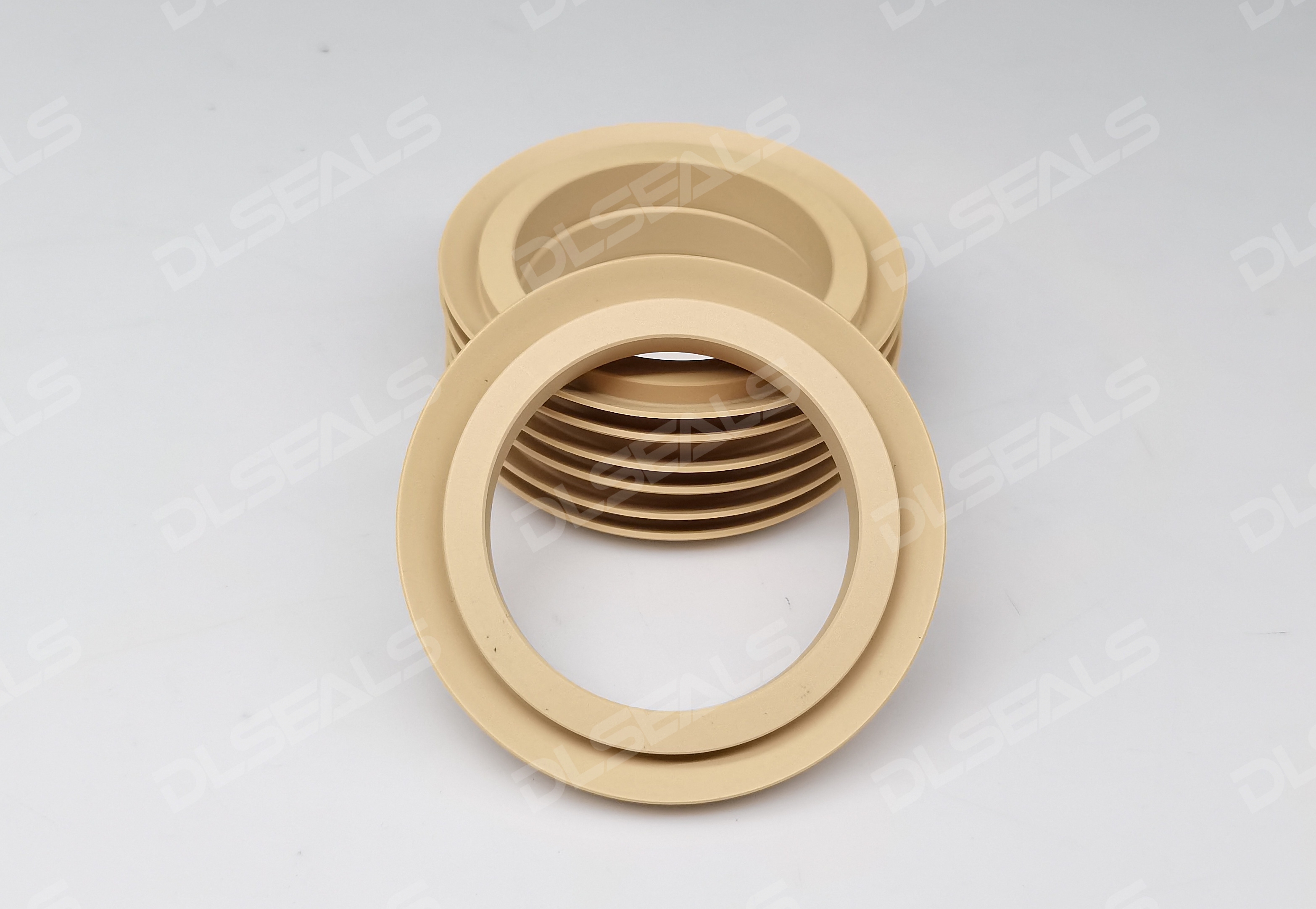
The CuSn6 bronze-PTFE composite achieves synergistic performance:
| Component | Function | Mechanism |
|---|---|---|
| PTFE Matrix | Chemical inertness / Low friction (μ=0.02–0.1) | Molecular chain slippage |
| Bronze (25–40%) | Thermal conductivity ↑800% | Metallic heat network (k=4.5 W/m·K) |
| Graphite (5%) | Boundary lubrication | Transfer film formation |
(ASTM D3702 / ISO 11014 Test Data)
| Parameter | Pure PTFE | 25% Bronze | 40% Bronze |
|---|---|---|---|
| Thermal Conductivity | 0.25 W/m·K | 2.1 | 4.5 |
| PV Limit | 0.5 MPa·m/s | 0.85 | 1.2 |
| CTE (×10⁻⁶/K) | 120 | 45 | 25 |
| Hardness (Shore D) | 55 | 68 | 72 |
| Wear (mg/1000 rev) | 35 | 9 | 5 |
Key Advantages:
Triple-Gradient Sealing System (>20 MPa):
[Primary Seal]  ┌─40% Bronze ┐ → Pressure/thermal load
                ├─25% Gradient┤ → Stress buffering
[Flexible Zone] └─Pure PTFE ┘ → Deformation compensationDynamic Sealing Mechanism:
| Application | Solution | Verification |
|---|---|---|
| Wind turbine pitch cylinders | 30% bronze PTFE step seals | PV=0.9 MPa·m/s at -50°C |
| Injection molding units | Dual-gradient glide rings | >150k cycles @ 230°C |
| Ship rudder systems | Bronze-PTFE + 304SS backing | Zero corrosion @ 35MPa seawater |
Hydraulic System Test Data (35 MPa):
| Metric | NBR Seal | Bronze-PTFE | Improvement |
|---|---|---|---|
| Leakage | 23.5 ml/min | 0.8 | ↓96% |
| Breakaway friction | 4500 N | 1200 | ↓73% |
| Service life | 1,800 h | 12,000 | ↑567% |
Gradient Compaction:
Surface Engineering:
| Condition | Recommended | Avoid |
|---|---|---|
| Pressure fluctuations | ≥30% bronze + anti-extrusion ring | Unreinforced PTFE |
| >200°C operation | ≥40% bronze layer | <15% bronze content |
| Abrasive media | ≥70 Shore D surface | Untreated surfaces |
| >1 m/s reciprocation | 3–5% graphite addition | Dry running conditions |
Next-Generation R&D:
[DLSEALS kindly Reminder] Sealing issues? Turn to DLSEALS! As a sealing component manufacturer, we specialize in customizing sealing components, providing a full range of services from design, research and development, production, testing, and more. If you have more information you'd like to know, feel free to contact us directly. DLSEALS's product experts are dedicated to serving you!

GUANGDONG DLSEALS TECHNOLOGY CO.,LTD.
TEL/Whatsapp
:+86 15918359971ADDRESS
:No. 2 Niujiaokeng Road, Baizhoubian, Dongcheng District, Dongguan, Guangdong, China.